
Noah didn’t like to be touched.
He flinched when I brushed his hair from his face.
Pulled away when I reached for his hand.
Even as a baby, he preferred the space between us —
wide enough for a breeze,
but heavy enough to break my heart.
Other moms would post pictures —
sticky toddler kisses, couch cuddles, bedtime snuggles.
And I would scroll,
and smile,
and wonder what it would feel like
to hold my son without resistance.
It wasn’t that he didn’t love me.
I knew he did — in his own way.
It was in the way he lined up his blocks beside me.
The way he copied my cough when I was sick.
The way he looked at me from across the room,
eyes wide, like maybe I was the only thing he trusted.
But still…
No hugs.
No arms flung around my neck.
No tiny head pressed to my chest.
Just space.
And silence.
When the developmental specialist used the words “sensory defensiveness,” I nodded like I understood.
But inside, I felt lost.
Not because I wanted him to be like other kids —
but because I didn’t know how to love him in the way he needed.
I wanted to scoop him up and hold him.
But what he needed was for me to sit quietly nearby.
I wanted to wrap him in a warm towel after baths.
But what he needed was the soft, dry cloth he chose himself.
It felt like parenting with gloves on.
Careful.
Quiet.
Uninvited.
Until one afternoon changed everything.
We were at therapy — a Wednesday session, after a long morning of protests and tears.
Noah was working with Miss Sara, his occupational therapist.
They were building a “calm cave” — a tent made of pillows and blankets, fairy lights strung across the top.
A space Noah had helped design.
His space.
His rules.
Miss Sara whispered to me, “Let him invite you in.”
So I waited by the edge, sitting cross-legged, silent.
Noah peeked through the tent flap,
then disappeared.
Then peeked again.
Then slowly — slowly — lifted the flap.
My heart stopped.
He didn’t speak.
He didn’t smile.
But he patted the spot beside him.
It was the first invitation I’d ever gotten.
I crawled in — carefully, slowly, like approaching a wild animal who might vanish if I breathed too loud.
We sat together in that soft, glowing cave.
No talking.
No touching.
Just quiet presence.
He picked up a plush animal and set it in my lap.
Then handed me another.
And another.
And then —
as if he didn’t even mean to —
he leaned.
Just a little.
Just enough for his shoulder to brush mine.
I didn’t move.
Didn’t dare.
He stayed there, barely touching me, for 37 seconds.
I counted every one.
My throat tight with the weight of it all.
The days after that were full of more quiet miracles.
He began sitting closer on the couch.
Letting my hand linger on his back for a moment longer before pulling away.
Still no hug.
But something was changing.
He was coming closer.
And I was learning patience in the purest, hardest form.
Then came the morning it happened.
It wasn’t therapy.
It wasn’t planned.
It was just a regular Tuesday —
toast on the counter, cartoons playing softly, shoes missing from where they should be.
Noah was standing by the door, watching the rain fall outside.
His backpack already on, his hood too big for his head.
I walked over, crouched to fix his zipper, and whispered,
“You ready, bud?”
He turned,
looked up at me —
and without a word,
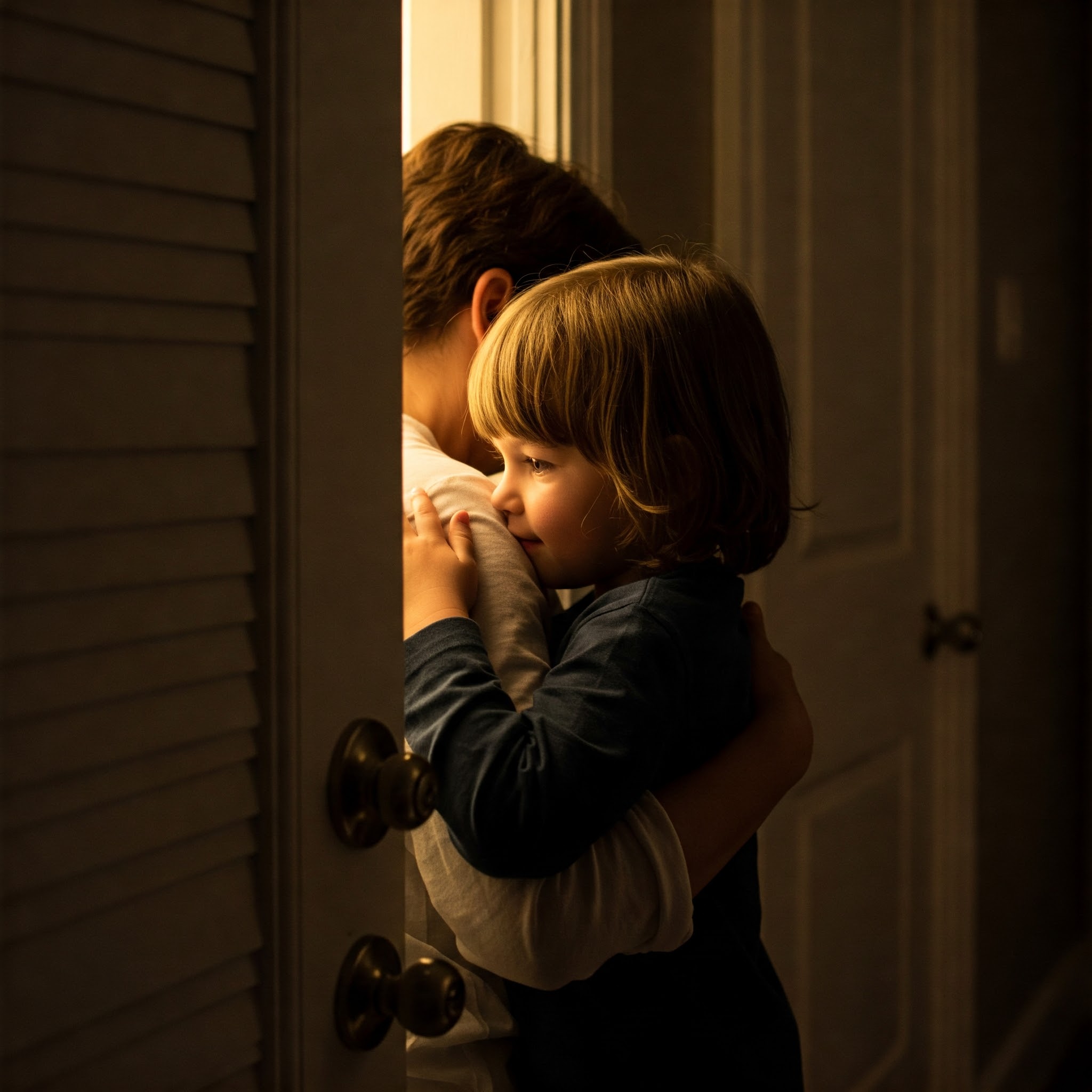
wrapped his arms around my neck.
I didn’t move.
I couldn’t move.
Because the world had just paused.
Tiny arms.
Tight grip.
His cheek pressed against mine, warm and real and entirely him.
I didn’t cry.
Not then.
I just held on.
Held him like he was the most fragile thing in the world,
and also the strongest.
Held him like I’d been waiting his whole life for this moment.
Because I had.
And when he finally pulled away, he looked confused —
like maybe he wasn’t sure why he did it.
But I smiled and whispered,
“Thank you, sweetheart. That was the best hug ever.”
He nodded.
Then turned back to the window.
And that was it.
But for me?
That was everything.
That night, I sat by his bed after he fell asleep.
His blanket half-twisted, his arm slung over his stuffed fox.
I whispered into the dark,
“I never needed you to hug me. I just needed to know you could — if you ever wanted to.”
And now I knew.
Love looks different in every child.
For Noah, it was space, then slow steps.
It was soft glances, shared toys, and finally — finally —
a hug.
Not because I asked.
Not because I earned it.
But because he chose it.
And that makes it the most beautiful gift I’ve ever received.